Willpower Is For Fat People

Because getting in shape shouldn't suck

  • Home
  • Blog
    • Polls Archive
  • Undieting
    • You are not me
    • How to lie with science
    • Are you steam powered?
    • Eating is not a sport
    • You are NOT what you eat
    • Eat consciously — except when you don’t
    • Diets don’t burn fat, they burn money
  • About
    • About Me
  • Contact
  • Daily Weigh-in
  • Forum

Powered by Genesis

Willpower is your goalie

By Drew

Goalie

Photo by Chris Schmich.

Every hockey team wants a great goalie. But the truth is if the rest of the team is good enough you don’t even need a goalie. Keep the puck at the other end of the ice and the goalie spends the whole game standing there bored. He’s a last resort when your game plan fails.

When you’re trying to change a habit, willpower is your goalie. You want to be able to block all the temptations coming your way, but face enough shots and some are bound to get through. The problem with dieting — well … one of the problems — is that you can spend tons of effort resisting, then one moment of weakness and it’s like you haven’t even tried.
[Read more…]
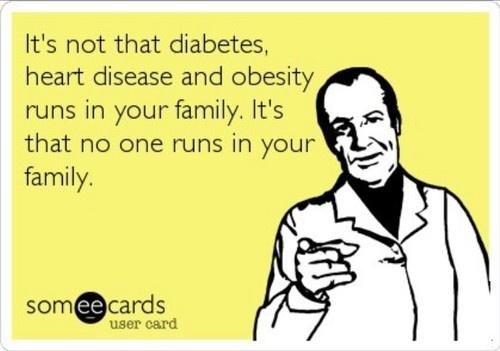
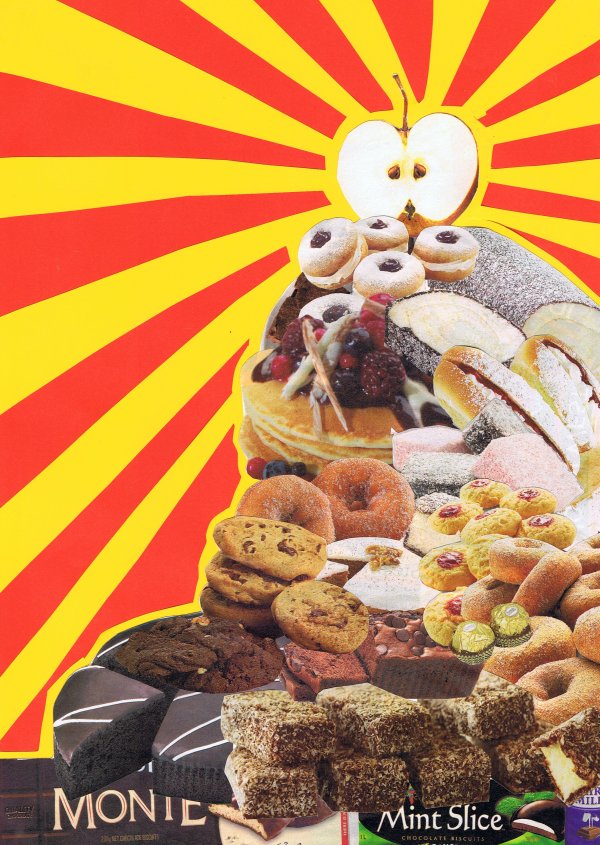
I know, let’s blame your parents!

By Drew

No one runs Have you ever seen a family at a football game, all in matching outfits, faces painted in team colors? Isn’t it a coincidence that the kids all just happen to like the same team as their parents? (I could have gone with religion for this, but that would be poking a hornets nest … oops.)

Even the most rebellious kid soaks up most of their worldview from their parents. Like maybe they’ll switch team loyalties when they move away, but they’ll still watch football.

The tricky thing is how much of this you don’t even know is happening. For instance, which of these is you?

  • It’s not whether you win or lose, it’s how you play the game. – Grantland Rice
  • Winning isn’t everything, it’s the only thing. – Red Sanders
  • Winning is only half of it. Having fun is the other half. – Bum Phillips
  • If winning isn’t everything, why do they keep score? – Vince Lombardi
  • The score never interested me, only the game. – Mae West

There are parts of your life you live like Red Sanders, and other parts like Mae West. But unless you’ve been in therapy for years to figure yourself out, chances are there’s no rhyme or reason other than that’s how you’ve always done it. And guess where that probably came from.

Right, it’s your parents’ fault

Deciding you want to root for a new team is easy. Realizing the reason you hate exercise is because you can’t stand competitiveness … yeah, that’s a little harder.

But here’s the thing. You might have developed your current hang-ups the old-fashioned way; you learned them from your parents. But part of growing up is taking responsibility for your own decisions.

If you’ve thought about it and you really believe taking care of yourself isn’t worth the hassle, whatever … you be you. Just don’t inherit that view from someone else because it was too much trouble to think for yourself.

You can’t “add healthy” to junk

By Drew

Jen Meister

Photo by Jen Meister

It’s always good to hear someone is trying to eat healthy. Problem is, we’ve been getting such bad advice for so long that people don’t know what that actually means.

For instance, a bowl of Chocolate Frosted Sugar Bombs topped with a handful of sprouts is not healthy.
[Read more…]

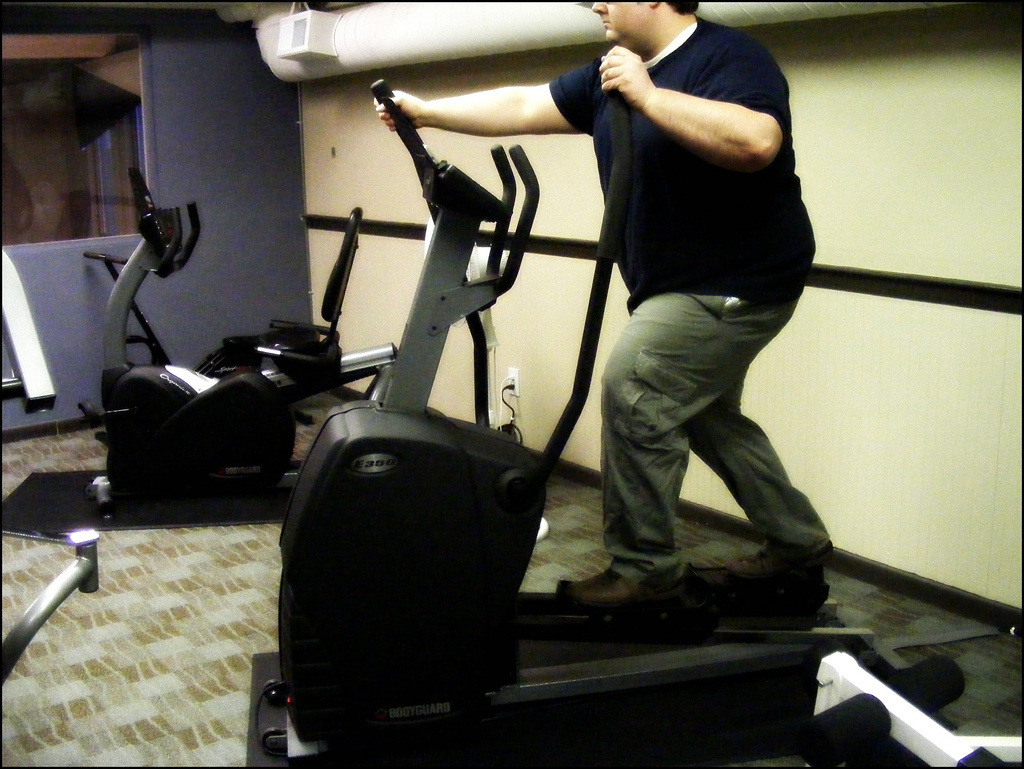
Don’t you just love how horrible this is?

By Drew

Eliptical

Photo by Robert Anthony Provost

Lots of things in life are better to have done than to be doing. For instance, surviving an avalanche. Great story to tell, cool life experience, not exactly the most fun while it’s happening though.

Just like being on The Biggest Loser. [Read more…]

Anybody want a cookie?

By Drew

Photo by lovecatz.

Photo by lovecatz.

A father of two small boys posted a story about teaching his kids patience. The older one, he asked whether he would rather have one cookie now or two cookies later.

He immediately responded, “Two cookies later.” I asked, “Why?” He said, “Because two is more than one.”

He later asked the older one to teach the younger one how to be patient. He asked his brother the “two cookies” question.

Without missing a beat, J said, “One cookie now.” (But he stopped crying!)

“Oh.” N paused some more. “Okay, would you rather have one cookie now, or 15 cookies later?”

[Read more…]

Good science questions everything, not just the parts you don’t like

By Drew

Photo by Aman Deshmukh

Photo by Aman Deshmukh

Doing science is hard. The stuff we already understand isn’t science any more; it’s engineering, or maybe design. If you want to do research you’ve got to ask questions that we don’t already know the answers to.

The second-biggest problem with that is that you can’t be sure when you’ve got the right answer, because you can’t just check the answer key in the back of the book.

The biggest problem is that you don’t even know the right questions to ask, because your assumptions — the things you “know” that aren’t so — are getting in the way.
[Read more…]

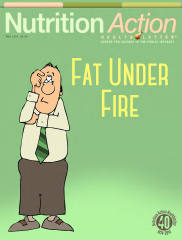
CSPI: Fat Under Fire

By Drew

CSPI Fat Under Fire

Center for Science in the Public Interest May 2014

If you’re properly cynical, whenever you hear the name of a special interest group you should always follow it up with a sarcastic, “Oh really?” Because it turns out the names that groups give themselves have more to do with what they want you to think about them than with what they actually do.

For example: The Center for Science in the Public Interest. “In the public interest? Oh really?”

CSPI could more accurately be called “The Center for the Advancement of Vegetarianism”.

Let’s take a look at the May 2014 publication to see how they misuse and abuse science to make their point.

Do as I say …

Before you can make an informed decision, you need some facts. But in the nutrition field there are few facts that everyone can agree on. The problem is that to figure out the long-term effect of eating a certain way, you have to do a long-term study. That means either you control what a lot of people eat for a long time — good luck with that — or you ask a lot of people what they eat, and compare their diet to their health.

Since controlling what lots of people eat for a long time would be ridiculously expensive, if you could even do it, no one tries. The best you’ll find are studies that last for a few months, generally with a captive population. Literally captive — like prisoners, or patients at an institution of some kind.

The other option, instead of telling people what to eat you ask them what they eat. That’s called an observational study, because you’re just observing them. But unless you ask them every day (and you don’t) you’ll get really bad results. That’s why observational studies should be used to raise questions, never to answer them.

The entire first half of Fat Under Fire makes exactly this point, saying that there are no “good” studies showing people who eat more fat are healthier than people who eat more carbs. So clearly the second half will introduce all the studies that show the opposite, right?

Well, sorta.

Let’s have a trial

There’s an old rule for lawyers:

If you have the facts on your side, pound the facts. If you have the law on your side, pound the law. If you have neither on your side, pound the table.

Martijn Katan, the source being interviewed, puts all his stock in trials. Those are the tests where you control what people eat. But does he pound the facts or pound the table? Let’s see.

There are five references at the end of the article, and none of the specific claims mention which of these he is talking about. But what do those five studies show?

Ann. Intern. Med. 160: 398, 2014

There were 32 observational studies (512 420 participants) of fatty acids from dietary intake; 17 observational studies (25 721 participants) of fatty acid biomarkers; and 27 randomized, controlled trials (105 085 participants) of fatty acid supplementation.

In other words, this was not a trial. It was an analysis of the results of 76 previous studies, only 27 of which were trials. The other 49 were observational studies.

Circulation 2013.doi:10.1161/01.cir.0000437740.48606.d1

Recommendations were derived from randomized trials, meta-analyses, and observational studies evaluated for quality, and were not formulated when sufficient evidence was not available.

Again, this is not a trial. It is a policy recommendation that refers to many trials … and observational studies and meta-analysis.

PLoS Med. 7: e1000252, 2010

Studies were included if they randomized participants to increased PUFA for at least 1 year without major concomitant interventions, had an appropriate control group, and reported incidence of CHD (myocardial infarction and/or cardiac death)… From 346 identified abstracts, eight trials met inclusion criteria, totaling 13,614 participants with 1,042 CHD events.

Okay, now we’re talking. This meta-analysis is at least focusing on the type of high-quality trial you would need. However … when you get into the details you see that people were advised on what to eat more of and what to eat less of, but it wasn’t strictly controlled and it wasn’t “blinded”. A “double-blind” study is one where neither the subject nor the researcher knows who is on which protocol, or in the control group.

Am. J. Clin. Nutr. 77: 1146, 2003

The effects of dietary fats on the risk of coronary artery disease (CAD) have traditionally been estimated from their effects on LDL cholesterol. Fats, however, also affect HDL cholesterol, and the ratio of total to HDL cholesterol is a more specific marker of CAD than is LDL cholesterol… We performed a meta-analysis of 60 selected trials and calculated the effects of the amount and type of fat on total:HDL cholesterol and on other lipids.

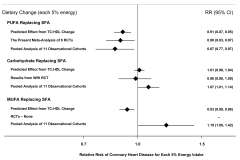
This one sounds good, too. But look at what it’s studying: the amount of HDL cholesterol in the blood. But click here to look at this chart from the previous study.

Image from Public Library of Science Click to view larger

Image from Public Library of Science
Click to view larger

When replacing saturated fat (SFA) with polyunsaturated fat (PUFA) the change in HDL suggests a decrease in heart disease risk, and that is exactly what the trials and observational studies showed. But when replacing SFA with monounsaturated fat (MUFA), though the change in HDL suggests a decrease in risk the observational studies actually show the opposite.

That suggests HDL by itself is not a reliable indicator of heart attack risk.

N. Engl. J. Med. 363: 2015, 2010

In a multicenter, double-blind, placebo-controlled trial, we randomly assigned 4837 patients, 60 through 80 years of age (78% men), who had had a myocardial infarction and were receiving state-of-the-art antihypertensive, antithrombotic, and lipid-modifying therapy to receive for 40 months one of four trial margarines: a margarine supplemented with a combination of EPA and DHA (with a targeted additional daily intake of 400 mg of EPA–DHA), a margarine supplemented with ALA (with a targeted additional daily intake of 2 g of ALA), a margarine supplemented with EPA–DHA and ALA, or a placebo margarine.

…

The rate of adverse events did not differ significantly among the study groups.

So this one showed … no effect from any of the things they tried.

That doesn’t sound really compelling, does it?

One meta-analysis of mostly observational studies, one policy paper based mostly on observational studies, one meta-analysis of trials that weren’t randomized, one meta-analysis of well-constructed trials that (unfortunately) are looking at a marker that doesn’t correspond well to actual health outcomes, and one well-constructed trial that shows no effect whatsoever from anything they tried.

I may be presenting the worst possible interpretation of every single one of these citations. But Katan and CSPI haven’t pointed to specific instances that support any of the claims Katan made. For a guy who spends so much time talking about how there aren’t good studies to back up someone else’s position, he sure doesn’t provide much evidence for his own.

Ignore your failures

By Drew

Photo by Kibbe Museum CC2.0

Photo by Kibbe Museum CC2.0

Everyone knows those parents that over-praise their kids. “Yay, Johnny used the potty!” Dude, Johnny’s nine.

But is it possible they’ve got something figured out that the rest of us don’t?

Positive reinforcement vs. negative reinforcement

I’m the last person who’s going to support the cult of unearned self-esteem. Want to feel good about yourself? Do something worthwhile and it’ll happen; you don’t need someone telling you how awesome you are.

But when we’re coaching and supporting someone, it’s easy to go too far the other way and only criticize. Because it seems to work. Every time you tell them they did a good job the next time is worse. But scream at them and they improve.

Here’s the thing, though: They would have improved even without the screaming. It’s called “regression to the mean”.

What’s “regression to the mean” mean?

I’m glad you asked.

Let’s say my average time in the 100m dash is 12 seconds. (It’s my thought experiment, I get to be super-fast if I want.) That means that sometimes I’ll be a little faster, sometimes a little slower. And after each run that is not exactly on my average, statistically the next run should move toward my average.

Photo by U.S. Navy CC2.0

Photo by U.S. Navy CC2.0

So I just ran a 12.9. That’s horrible for me. You’re coaching me, so you want to yell and scream. But before you do, realize that I was nearly a second off my average. Don’t say anything and odds are my next time is going to be significantly faster.

But if I set a personal record at 11.7 and you praise me, what happens next? Right, I do worse. So in your mind yelling at me makes me improve, and praising me makes me do worse.

This isn’t just a cool theory

The Navy is very interested in teaching people the right way to land planes on boats. Something about losing multi-million dollar assets and highly-trained personnel at the same time gives them the heebie-jeebies.

So when they heard the theory that regression to the mean causes inappropriate use of positive and negative reinforcement, they studied it.

Kahnemann and Tversky report that flight trainees who do well on a maneuver typically do not do as well on the next maneuver. Because they did not understand regression to the mean, the flight instructors attributed this regression to the praise the pilots received—leading to the perverse conclusion that pilots who do well should be criticized. Kahnemann and Tversky do not report any actual data to support this memorable anecdote. This paper uses U. S. Navy flight training data to demonstrate that there is substantial regression to the mean in pilot performances.

The paper gets into a lot of statistics, which math geeks will appreciate. But I’ll pull some highlights.

Pilots are scored from 0-5 on each landing: 0 is “unsafe” and 5 is “perfect”. No one get 0 or 5 in the sample data, so as a practical matter scores were from 1-4.

For the scores at the extreme, there is nowhere to go but toward the middle and most did: 83% of the 1s improved and 77% of the 4s worsened.

So a bad performance was nearly always followed by a better one, and vice-versa, regardless of what feedback they got.

But here’s the really interesting point. You can do worse and it’s still a positive sign.

This pilot’s estimated ability is 2.57. … This pilot would demonstrate an improved ability if, on the next day, the pilot’s score is above 2.57. Notice particularly that if the pilot’s score falls from 2.78 to 2.71, this is actually good news in that the score did not fall as much as predicted by regression to the mean.

In other words, even if today is worse than yesterday, if yesterday was already an exceptional day then you’re still doing better than expected.

Fascinating. Now what does that have to do with me?

Are you trying to lose weight? Did you just take one of the donuts at that meeting? Don’t worry about it, that was an exception. (It was an exception, wasn’t it?)

Or are you training for a 5k and you just finished a training run 15 seconds off your pace? No biggie, you’ll do better next time.

Not because you’re trying harder. Not because of willpower.

Because math.

Is there anything you *won’t* do for money?

By Drew

Photo by Andrew Magill

Photo by Andrew Magill


If you’re the California Dietetic Association, apparently the answer is “No”.

The CDA is the California affiliate of the Academy of Nutrition and Dietetics, which means you don’t get to legally call yourself a “dietitian” unless you’re licensed by them. So who do you think sponsored and catered their annual convention this year?

Go ahead, guess.

I don’t want to spoil the surprise. Go check out the article for the answer.

Then leave a comment below telling me if your guess was right.

How to eat an elephant

By Drew

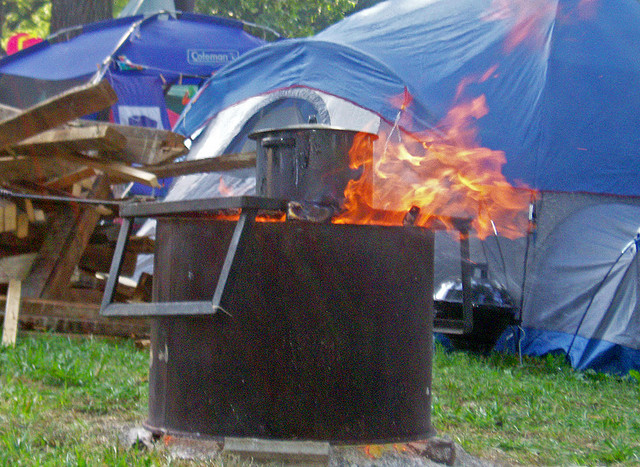
Campfire pot

Photo by N1NJ4

“One bite at a time.” Yeah, that’s the answer to the joke. But what if you really try to do it?

Hmm, well first I need to get an elephant, and they don’t have those down at the grocery store … or the pet store. Then I’ve got to kill it; how do I do that without getting trampled? And what the hell kind of knife would I need to butcher the thing?!

So you never start

People do this exact same thing with getting in shape all the time. They think about joining a gym, and learning to cook, and buying running shoes, and getting rid of all the chips and candy, and finding a source for grass-fed beef, and finding three hours per week in their schedule to work out, and do I even have pots and pans to cook with? And … and … and …

If you ever want to get somewhere you’re going to have to start. So just do that: Start. Pick something and do it. Learn one new low-carb recipe. Go for a walk after dinner before settling down in front of the TV. Do something easy, then do it again.

Don’t try to eat an elephant. Just try to eat one bite.

Next Page »

Recent Posts

  • Willpower is your goalie
  • I know, let’s blame your parents!
  • You can’t “add healthy” to junk
  • Don’t you just love how horrible this is?
  • Anybody want a cookie?

Recent Comments

  • Drew on I know, let’s blame your parents!
  • Murphy Kismet on I know, let’s blame your parents!
  • Drew on Anybody want a cookie?
  • June on Anybody want a cookie?
  • AHA wants you to kill yourself - Willpower Is For Fat People on What is that supposed to mean?