
Willpower Is For Fat People

Because getting in shape shouldn't suck

  • Home
  • Blog
    • Polls Archive
  • Undieting
    • You are not me
    • How to lie with science
    • Are you steam powered?
    • Eating is not a sport
    • You are NOT what you eat
    • Eat consciously — except when you don’t
    • Diets don’t burn fat, they burn money
  • About
    • About Me
  • Contact
  • Daily Weigh-in
  • Forum

Powered by Genesis

Solve your own damn problem!

By Drew

Screaming

Reason #743 that I don’t like most diets* is that the authors assume everyone is just like them. We’re not. Like I said before, “You are not me.”

One diet that I really want to like is the No S Diet. The entire plan is summed up in 14 words:

  • No Snacks
  • No Sweets
  • No Seconds

Except (sometimes) on days that start with “S”.

I love the simplicity of it. I love how sensible it is. I love everything about it, except …
[Read more…]


Are you steam powered?

Steampunk Fireman

I’ve got to yell you, sometimes writing about this stuff feels like cheating. I mean, the “conventional wisdom” about how to eat — the world according to the food pyramid, in other words — is wrong in so many ways that it’s sort of like shooting fish in a barrel. Everywhere I look there’s a piece of conventional wisdom to take apart.

Lets take calories for instance. We all know* that the way to lose weight is to eat less and exercise.
* NOTE: Whenever someone says “we all know”, the next thing out of their mouth is something that they can’t prove. That’s your first little life lesson. Look for another one coming up soon.

And we all know “eat less” means eat fewer calories. But …

What is a calorie?

A calorie is measure of heat. So when we say that a bag of crackers “has 100 calories” it means that if you put those crackers in a furnace, when you subtract the heat applied from the total heat produced you’ll end up with 100 calories. (Kilocalories, actually)

Read that definition again. I’ll wait …


Okay, got that? When we talk about how many calories a certain food has, we’re talking about how much heat is produced burning that food in a furnace

Bomb calorimeter

This is a bomb calorimeter. It is not your stomach.

If you’re steam-powered, that might be a useful thing to know. Are you steam-powered? No? Didn’t think so.

So why are we measuring how well food burns?

You’re going to love this one. We’re measuring how well food burns because … it’s easy to measure. That’s it, full-stop. There is no evidence whatsoever that calories have anything to do with weight or nutrition.

Here comes that second life lesson I told you was coming: Sometimes we measure things because they’re easy to measure, not because they’re actually useful.

It’s like the old joke about the drunk looking for his keys under the streetlight. A cop asks him, “Is this where you had them last?” The drunk says, “No, but the light’s better over here.”

If measuring food in calories worked the way we’ve been taught to think of it, eating 100 calories of sugar (about an ounce) would be the same as eating 100 calories of beef (about two ounces).

Think it’s that simple? Okay, here’s an experiment to show how even simple things can be surprisingly complex.

Try this at home

You’re going to make simple syrup. You’ll need it for mixed drinks on your weekly cheat day.

Get an empty jar, a cup of sugar, and a rubber band. Put a cup of water in the jar, then add the cup of sugar. Put the rubber band around the jar to mark the height of the water.

Now let the jar sit, stirring occasionally, until the sugar is all dissolved and the water looks clear again. You’ll note that the level has gone up.

As a reader told me on my other blog:

The level increases when the sugar is thoroughly dissolved because the sugar molecules are now distributed evenly throughout the solution instead of being concentrated in crystalline form.

As an interesting side note, even when mixing two liquids you can get an end volume less than the sum of the liquids’ two individual volumes. But that’s like, complicated, and I got a C in thermodynamics.

You can see how this went for me on my other blog.

What does this have to do with calories?

Well, not a whole lot, actually. It was just an example of how sometimes things that seem simple really aren’t. But it does get me to my point: What does burning food have to do with eating food? Not a whole lot, actually.

[private guest 3|guest 4|guest 5|guest 6|guest 7|guest 8|guest 9|guest 10]
Part 5: Eating is not a sport
[/private]

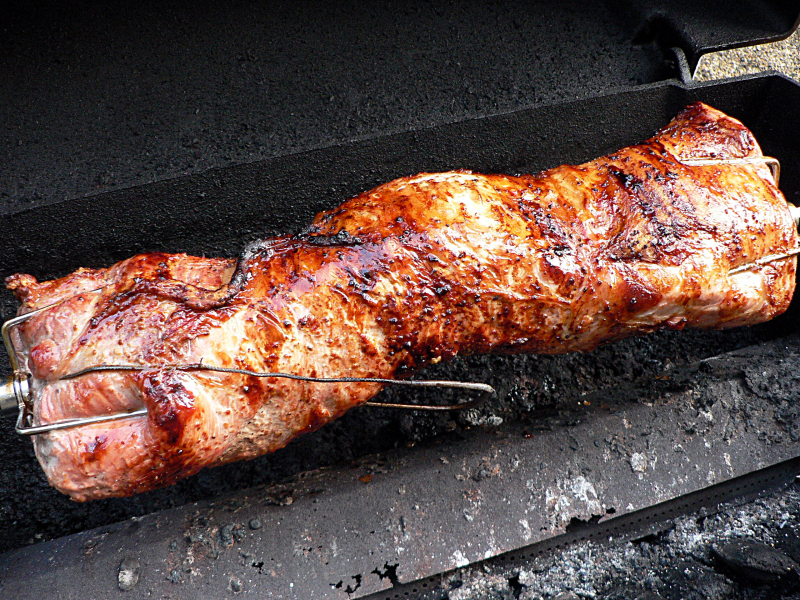
Rotisserie Pork Loin

By Drew

Originally seen at How To Cook Like Your Grandmother

Start with a good cut of meat and don’t screw it up. And the rotisserie makes that easy.

[nonmember] Join the undieters crew to download the printable recipe card. [/nonmember] [ismember]Recipe Card[/ismember]

How to lie with science

Mad scientist

My kids still believe everything I say just because I’m the one saying it. That’s pretty cool. It’s also cool that they both understood sarcasm by the time they were five, although that says more about me than about them.

But nobody else believes me just because I’m so awesome. I have to actually sound like I know what I’m talking about. You know, explain myself, make sense, stuff like that. Scientists, on the other hand, seem to get a free ride from most people. I think it has something to do with the white coats … people really seem to like those.

However …

Scientists can be wrong [Gasp!]

I’m a fan of science. After all, scientists brought us computers, air conditioning and hot air popcorn poppers. But they also brought us bloodletting, phrenology and eugenics, so maybe not all scientists are worth listening to.

The question is, how do we tell the difference?

It takes some practice, but you can usually get a feel for junk science by looking at three factors:

  • Assumptions
  • Methodology, and
  • Agenda

Here’s an example from a CNN article discussing a comparison of various diets:

Researchers at the Harvard School of Public Health and the Pennington Biomedical Research Center put four popular diets — high carb, high fat, low-fat and high protein — to the test to see which of the regimens resulted in more weight-loss success. After two years of monitoring the participants, “all the diets were winners,” said study co-author Dr. Frank Sacks, a professor of cardiovascular disease prevention at the Harvard School of Public Health. “All produced weight loss and improvements in lipids, reduction in insulin.

“The key really is that it’s calories. It’s not the content of fat or carbohydrates, it’s just calories,” said Sacks. The findings are published in the latest edition of the New England Journal of Medicine.

Let’s start with the …

Faulty assumptions

Their definition of a “high fat” diet was one where 40% of all calories from from fat. Is that a fair definition?

There was a study in 1960s performed by John Yudkin’s group at the University of London (get your copy here) where fat accounted for nearly 61% of calories consumed. Leaving aside the results of the Yudkin study — which I’ll come back to — it’s clear that the recent Harvard study was really comparing low-fat to very-low-fat diets. A genuinely high fat diet was never even considered.

And remember that conclusion — “It’s not the content of fat or carbohydrates, it’s just calories” — I’ll be coming back to that, too.

Flawed methodology

If the goal is to compare different diets, you need some way to control what people are actually eating. But according to the CNN article:

Participants could attend individual sessions where dieticians educated them and group sessions where they discussed their experiences with one another. Those who had better attendance in the sessions had stronger weight-loss results. “These findings together point to behavioral factors rather than macronutrient metabolism as the main influences on weight loss,” according to the study.

That means study participants were assigned a diet to follow, but their compliance was a matter of individual effort. And diet subjects are notoriously bad at self-reporting what they ate.

Assuming this flawed methodology works anyway, the scientists properly concluded that behavior — how well did they stick to their diet — was a better predictor of results than which diet a participant was assigned. This study was unable to conclude anything about which diet was better.

A conclusion that the co-author completely contradicts in his summary … quoted in the beginning of the article … the part most likely to be read by most people.

Different agenda

Note who did the study: a professor of cardiovascular disease prevention. Weight loss was only one of several factors used to judge success of the diets: “All [diets] produced weight loss and improvements in lipids, reduction in insulin.”

These three factors are believed by some researchers to affect heart health. But the study didn’t actually measure cardiac outcomes. To conclude anything about heart health from this study, you would have to accept the lipid hypothesis.

(By the way, I realize I’m linking to a ton of extra reading here. But there’s a lot of research that suggests the last several decades of official recommendations have been wrong. There’s a lot more that I could be linking if I wanted to.)

It all adds up to: just plain wrong

So if this study wasn’t really comparing high fat to low fat diets … if they didn’t control what people actually ate … if they weren’t even looking primarily for effects on weight … are there any studies that didn’t have these flaws? As a matter of fact, there are.

The Yudkin study, which I mentioned earlier, placed subjects on a high fat diet — 61% of calorie intake — and found that people spontaneously limited themselves to less than 1600 calories per day. They felt full and lost weight.

Decades earlier, in 1944, Ancel Keys performed a starvation study where subjects were placed on an extremely low fat diet — just over 17% of calories. The total calorie intake was nearly identical to the Yudkin study but in the starvation diet people became emaciated, obsessed with food, and in several cases developed significant psychological problems.

There’s a really good analysis of these studies at The Four Hour Workweek in The Science of Fat-Loss: Why a Calorie Isn’t Always a Calorie.

If you find this conclusion a little hard to believe, think about this: One rice cake is about 35 calories. One cubic inch of beef jerky, three or four strips, is 49 calories. Which snack would satisfy your hunger longer, two rice cakes or a small bag of beef jerky? The rice might fill your belly, but you’ll still be hungry.

Enough crying wolf

Food scientists, politicians and food industry spokesmen have told us fat is bad, vegetable shortening is good, cholesterol is bad, carbs are good, carbs are bad, some cholesterol is good, vegetable shortening is bad, some fat is good … And this time they’re sure.

I haven’t seen any study that makes a definitive conclusion about a single nutrient. I haven’t seen any study showing that a radical new diet is better for the general population than any of the traditional diets. Until I do, I’m going to keep eating beef, bacon fat, butter, whole milk … and fresh fruits and vegetables, and home-made bread and pasta. And writing about it right here.

[private guest 2|guest 3|guest 4|guest 5|guest 6|guest 7|guest 8|guest 9|guest 10]
Part 4: Are you steam powered?
[/private]

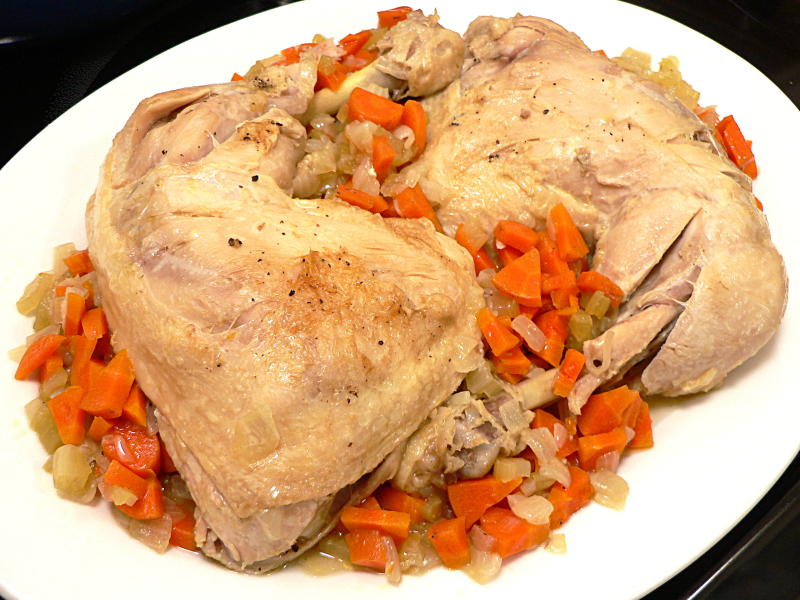
Potted Chicken with Chicken Stock

By Drew

Complete recipe and step-by-step directions at How To Cook Like Your Grandmother

This recipe is not just easy, it’s versatile. You can serve it as-is, and it makes a great hearty dinner. Or pick the meat off the chicken pieces, put everything back in the pot, add water and lentils and turn it into soup.

Personally, I’d rather have the lentils on the side, since they turn the chicken an ugly color. But it’s really easy to store cups of prepared soup to eat the rest of the week.

[nonmember] Join the undieters crew to download the printable recipe card. [/nonmember] [ismember]Recipe Card[/ismember]

The lost weekend

By Drew

The Lost Weekend with Ray Milan and Jane Wyman, by Billy Wilder

The Lost Weekend with Ray Milan and Jane Wyman, by Billy Wilder

I don’t want to give the impression that I visit Philadelphia just for the food. But planning how to fit all my favorites into just one day of free time does take up quite a bit of effort:

  • Cheesesteak with grilled onions and sweet peppers from Michael’s
  • Special Italian hoagie with sweet peppers, also from Michael’s
  • Hot sausage with sauce and onions from The Last Stand
  • Soft pretzels from Wawa

Add in the road food on the turnpike between Cleveland and Philly, dinner at the wedding Friday night (the real reason we made the trip), and road food on the way back, and my daily weigh-in looks like a politician taking a polygraph.

Here’s where it will get interesting

If my research is correct, I’ll be back to my pre-binge weight by Thursday morning, without skipping meals or doing anything out of the ordinary.

My wife sets the over/under at Friday morning. Who wants a little of this action?


Truth hurts sometimes

By Drew

boobs
Some things in life you’d rather not know. As long as you never say this stuff out loud, you can convince yourself that you don’t know about it:

  • Your husband looks at other women’s boobs.
  • Your wife buys shoes you don’t know about.
  • Your teenager is having sex. Yes, your teenager. With someone they met in bible study. (If you’re lucky it’s another student.)

If there’s nothing you can do about it anyway, you might as well pretend it isn’t so and save yourself the stress of wishing it would change.
[Read more…]

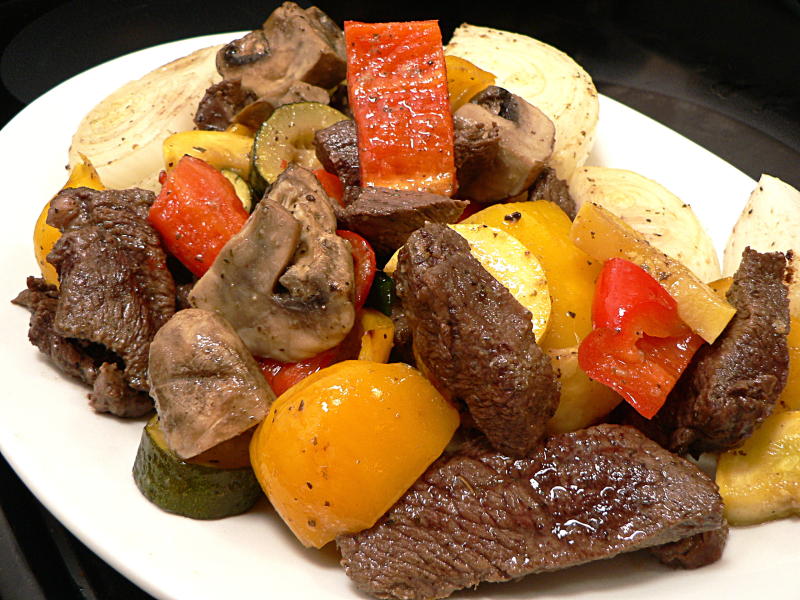
Stickless Shish-Kabobs

By Drew

Full recipe and step-by-step directions at How To Cook Like Your Grandmother

The first kebabs — and I can’t even write that without hearing it in Jamie Oliver’s voice — were made by soldiers cooking meat by skewering it on their swords and holding it over camp fires. Well, that’s what the Arabic tradition says anyway. But like anything popular, everyone is trying to claim it.

Use the sword if you’ve got it. Or use this method that doesn’t require a sword … or an open fire … or any cooking skill whatsoever.

[nonmember] Join the undieters crew to download the printable recipe card. [/nonmember] [ismember]Recipe Card[/ismember]

You are not me

conformity

The first rule of Undieting is, don’t talk about … wait, wrong movie.

The first rule of Undieting is that you are not me. That’s kind of the rule for lots of things, actually, but it’s really important when it comes to eating. Because you don’t like the same things I do.

You have to like it — unless you don’t

Bookstores are littered with diet books by super-human genetic freaks with abs that can cut glass, telling you how they lost weight on a diet of croutons and kelp. Unless you really like croutons, odds are you won’t be sticking with that diet no matter how much weight you lose.

Which is why people who love food have such a hard time sticking to diets. We barely get started on them before we realize it ain’t gonna work.

But some people do like croutons and kelp. So for them, a lifetime eating like that doesn’t sound like such a bad deal.

In all seriousness, some people just don’t care about food. They don’t care what they eat. Food is fuel.

Ignore those people

Not because they’re wrong. They’re not. They are 100% right … for them. But they’re wrong for you, because you have different priorities.

Don’t take advice that you don’t agree with. Only you know what’s right for you.

And if that means kelp? Well, I can’t help you there. I’m sure you can find some recipes online.

[private guest 1|guest 2|guest 3|guest 4|guest 5|guest 6|guest 7|guest 8|guest 9|guest 10]
Part 3: How to lie with science
[/private]

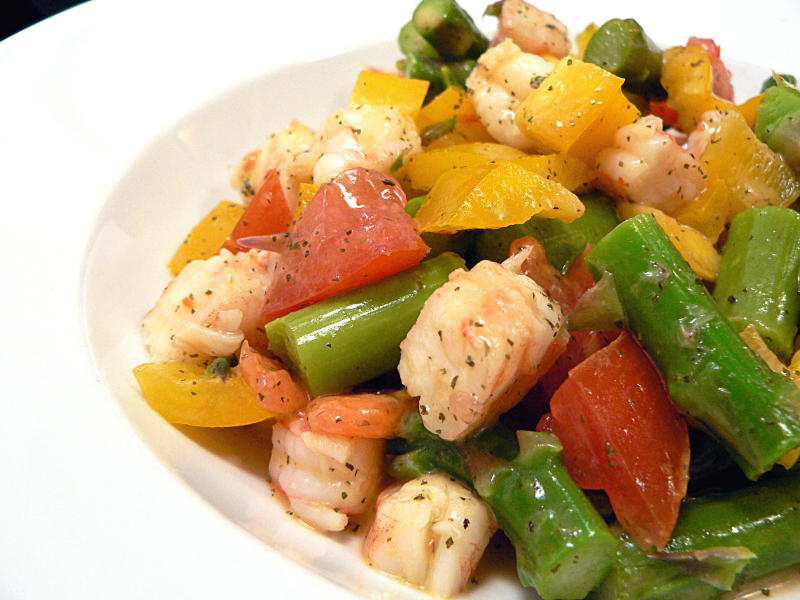
Asparagus and Shrimp Salad

By Drew

Full recipe and step-by-step directions at How To Cook Like Your Grandmother

Jenn first had a version of this at a fancy brunch. It’s so easy to make, though, that there’s no reason to hold it for special occasions.

Don’t skip the step where you blanch the asparagus. It only takes a couple of minutes but it makes all the difference in texture, and even improves the flavor a bit.

[nonmember] Join the undieters crew to download the printable recipe card. [/nonmember] [ismember]Recipe Card[/ismember]

« Previous Page
Next Page »

Recent Posts

  • Willpower is your goalie
  • I know, let’s blame your parents!
  • You can’t “add healthy” to junk
  • Don’t you just love how horrible this is?
  • Anybody want a cookie?

Recent Comments

  • Drew on I know, let’s blame your parents!
  • Murphy Kismet on I know, let’s blame your parents!
  • Drew on Anybody want a cookie?
  • June on Anybody want a cookie?
  • AHA wants you to kill yourself - Willpower Is For Fat People on What is that supposed to mean?