I’ve spent most of my adult life working in software development. I know that the best programs are the ones that you don’t have to think about to use them.
It’s true of physical products too. The iPod didn’t win the market because it did things no other music player could do; it won because people could listen to their music without thinking about the player.
Modern marketing is all about convincing us that we shouldn’t think too hard. They’ll provide us a ready supply of pre-formed opinions, ready for making our shopping decisions.
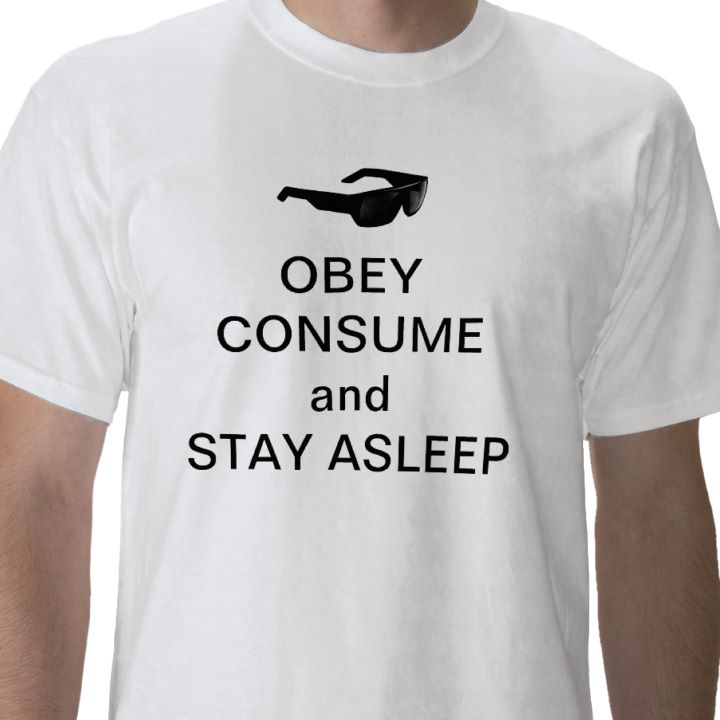
I don’t usually quote Roddy Piper movies, so instead I’ll quote this review of They Live
What makes They Live so appealing, of course, is that the dystopian ‘truth’ revealed by the glasses resembles so closely what we in fact already know of our own present. The world’s wealth really is controlled by an elite of “free-enterprisers” (as the aliens are referred to at one point) for whom “there are no countries anymore”. This elite really are strip-mining the earth of its resource and really are backed up by the force of the police and the military. Many television programmes and magazines really do tell us nothing but to consume and go back to sleep. And the levels of methane and carbon dioxide in our air really are rising as if to prepare the atmosphere for some colonising alien species.
Maybe you don’t remember They Live, but you’ve surely heard one of the all-time great movie lines, said by Piper in this late-80s classic:
I have come here to chew bubblegum and kick ass … and I’m all out of bubblegum.
What does this have to do with eating?
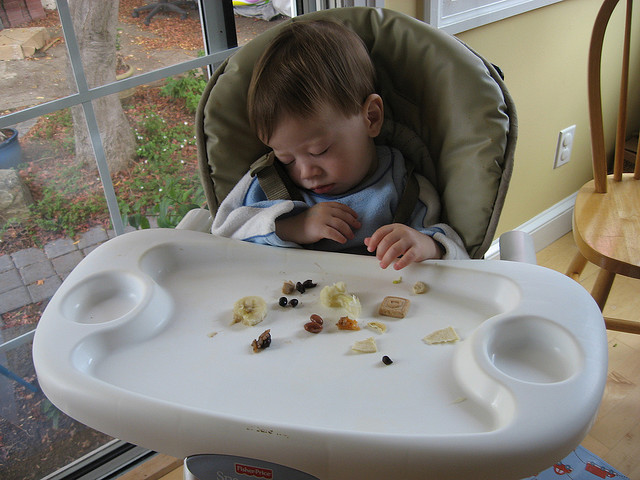
Glad you asked. Whenever you hear parents talking about their infant being a “fussy eater”, what they mean is that the kid has functioning taste buds and he doesn’t like what they’re feeding him.
Have you ever tried a bite of some of the stuff in those tiny jars? Holy crap it’s nasty. But when a baby acts like it’s nasty, we just keep shoving that spoon into his crying mouth, blaming him for noticing it’s nasty. Most of us were trained from childhood to eat whatever is put in front of us, and ignore what our taste buds and our stomaches are telling us.
It continues in adulthood when commercials bombard us with images of huge, overflowing platters of engineered food — at restaurants of for home re-heating — that we would never in a million years cook for ourselves. Have you seen the recent Wendy’s commercials where they dip breaded chicken patties in “Buffalo sauce”? I like wings, and even I think that thing looks gross.
We aren’t supposed to notice that
Lots of food writers and chefs talk about people “eating consciously”, meaning they want people to pay attention to what they eat. Don’t just mindlessly grab whatever is convenient.
But what if that’s exactly why people eat garbage? Maybe they don’t want to be conscious all the time? I think Ta-Nehisi Coates is exactly right about this one:
The bigger thing here is understanding why people go to McDonald’s in the first place. I strongly suspect that the entire experience is comforting. In a day of constant work, pushes and pulls, you have this one clean place, which is the same everywhere, dispensing joyful shots of sugar and salt. That’s just me thinking about how I’ve eaten the past — and also how I eat when my brain is crowded with everything besides what I’m eating.
I think what Bittman urges in his writing is is consciousness. He wants people to think hard about what they’re eating. I strongly suspect that people go to McDonald’s for the exact opposite reason–to get unconscious. Understanding why that it is, goes beyond our food. It’s about how we live.
Yeah, that feels right. I don’t go to McDonald’s regularly. I’ll actually pick just about anything else, given the choice. But if I’m on the turnpike and need something quick so I can stay ahead of the rain? Sure, at that moment I’ve got bigger things to worry about than being conscious of what I’m eating.
Choose to be unconscious
It’s one thing to choose, for one meal, to eat unconsciously. It’s another thing to do it all the time. That’s bad … don’t do that.
One example is thinking that you can make all your food decisions by following one simple rule. Going gluten-free, for example. Modern Alternative Mama pointed this one out:
Yes, too much gluten is bad for us. Yes, a lot of people are sensitive to it. Yes, we do have many people who are diagnosed with celiac, and avoiding gluten is crucial to their health.
But the real problem is that we just eat too many grain-based foods. Going gluten-free, especially when people do it because it’s “popular” rather than out of a real health need, is just a way to eat the same amount of grains — just different ones.
But many gluten-free products are highly processed and not particularly healthy.
In other words, by all means go gluten-free if you have a specific need. But if you use “gluten-free” as a shorthand for “less carbs”, there are plenty of manufacturers standing by to produce high-carb gluten-free food. Because they are very conscious of what you’re eating and how you’re thinking about it.
Wake up … or don’t
It’s up to each of us to decide for ourselves how much we care about what we’re eating. Choosing to be mindful sometimes but not all the time is a personal choice.
But being mindful isn’t something you can do once and be done with it. It’s something you have to make a part of your daily life.
Of course, avoiding processed food as a general rule does get you around most of what’s wrong with the Standard American Diet without having to think much about it.
Oh hey, did I mention …
I made a shirt for They Live fans? Check it out: